Episode Transcript
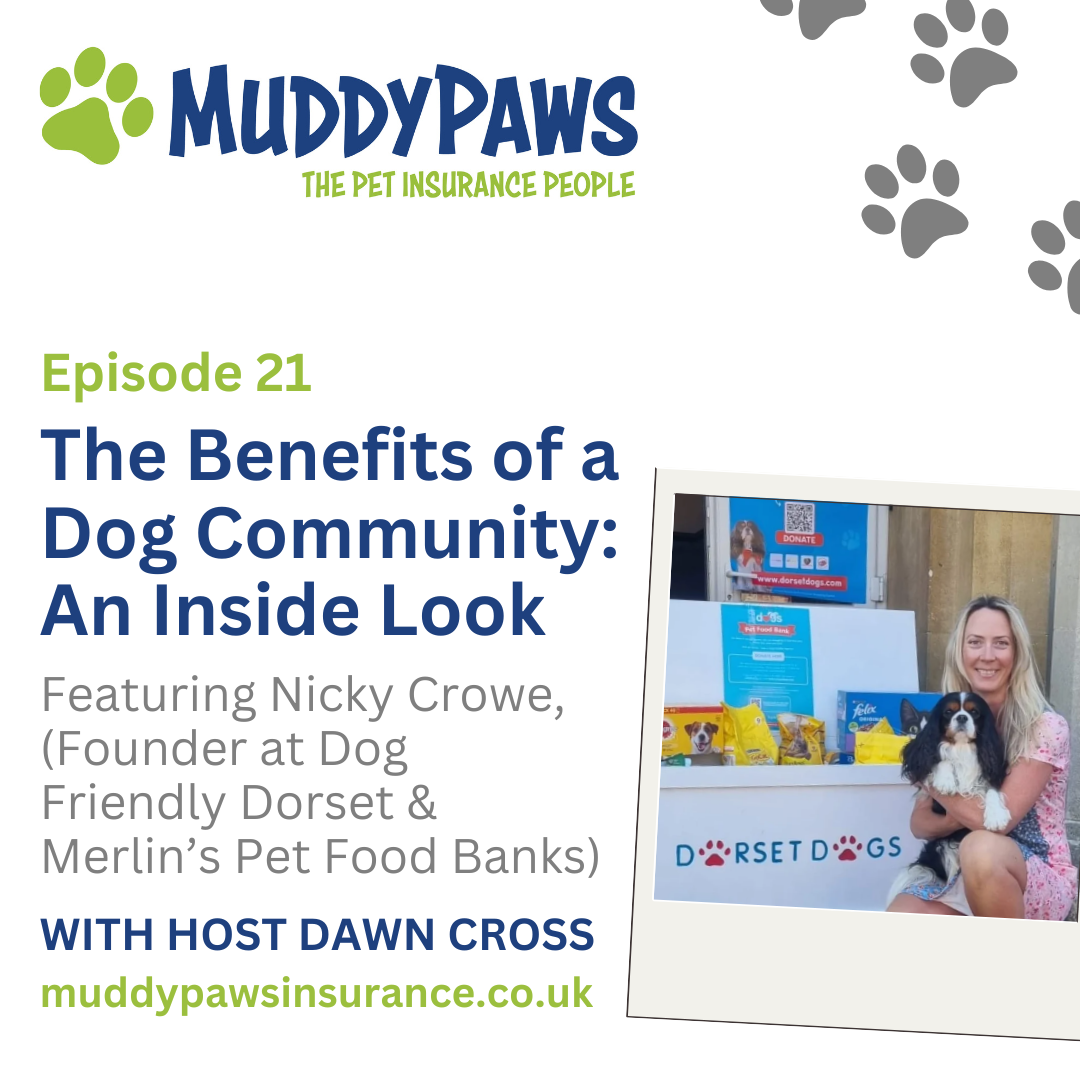
[00:00:01] Speaker A: Welcome to the Muddy Paws Insurance Podcast. I'm your host, Dawn Cross, and today I'll be chatting about the benefits of dog community with Nikki Crowe, founder of Dog Friendly Dorset and Merlin's Food Banks.
If you enjoy our podcast, make sure to leave a rating on your favorite podcast directory.
Well, thank you so much for coming on today. If I get you to start off with, you know, who you are and what is your background.
[00:00:27] Speaker B: Yeah. Hi. Thank you so much for having me, dawn, and for this invitation.
So I'm Nikki and I'm sort of known as Mickey Merlin. Merlin is my dog, but he has refused to take part today.
He's got a sore body, so, you know, can understand. We all know what that feels like anyways, so I wear, like, many hats. I have many different roles. I'm a Gemini Moon, so any astrologers or astrology students will know what that means.
But I am a qualified behaviorist, and I have set up Dog Friendly Dorset. So I'm the founder, so I have a charitable ambassador role and also operations to help pets in need and through our community.
Yeah, I advocate for dogs and for animals that don't have a voice.
And then through my work as an astrologer and as a therapist, I help humans and I help dogs behaviorally as well.
[00:01:37] Speaker A: God, sounds amazing. So how did you get into all of that in the first place? Is it like you've always been wanting to do, or is it something maybe that's a bit more just like, you know, actually, I've got such a liking for this. Like, I've got such a skill for this.
[00:01:50] Speaker B: Yeah, well, my dogs have brought me into it, so I also haven't mentioned that I'm an animal and nature communicator, and I also heal animals, but it has come through.
So I've always had Cavalier King Charles, and the breed itself does have a number of health issues.
It's quite predominant in that breed. And so my lifetime of owning seven Cavalier King Charles, I'm honored to have.
I have also become a healer, and I work with plant remedies and I work with first aid and preventative options that, you know, around the breed.
So. So, yeah, so my dog. Actually, my dog Milo brought me into being a behaviorist because he got attacked.
And I organized an event with a very good behaviorist in Manchester at the time. And I was just so impressed about how he could help. You know, like 100 people came to this event. I was only expecting, like, 12. And it just really made me think, hold on a second. There's something Here that, yes, I can learn from my own dog, but I can also help other people. Yeah. So I think that installation at the beginning.
[00:03:10] Speaker A: Oh, well, that's amazing. I think it's really great that obviously you've kind of. With stuff that you've found that's quite horrible. You know, especially when your own pet does get attacked. It's really a horrible experience, especially if you can't prevent or, you know, it's really hard to get in between two dogs. You probably don't want to get in between two dogs, and it's. It's very difficult. So kind of finding this, like amazing skills and learning off the back of that is always amazing because unfortunately it's through bad lived experience. But then you help others.
Well, which is, you know, something that's always amazing to do.
[00:03:45] Speaker B: Yes. And I could help my dog because as a parent, I realized that I have a responsibility where I could have perhaps seen the signals early enough. And that's why I teach body language, animal body language and dog body language.
And so now I'm in a better position personally. But also to help others. Yeah. Because it's a great, great responsibility to be a dog parent.
[00:04:11] Speaker A: Yeah, 100%, I think, just, you know, being a parent of anything, whereas, you know, if you've got actual children or you've got cats or you've got parrots or, you know, any sort of animal, it's very key to understand them in their full capacity as much as you can. Because sometimes it's. It's more than just, okay, you throw the ball for the dog, you feed them, you. You do a bit of playing and cuddling. NASA, there's so much more on a deeper level, and we did a recent episode with another animal behaviorist where she actually helps. She's also a trained vet. Helps to kind of look at these body language things as well as, you know, help with the diagnosis of. Okay, is this a medical issue with them as well? And it's amazing to see that more people becoming more aware or even training to learn this because personally, I don't see it being talked about enough.
[00:04:59] Speaker B: Yeah, exactly. And so certainly, like I work with. I'm an intricate healer, so I work alongside veterinary professionals. And it's like the links between behavior and like, what you just brought up the fact that it can be a health condition. It's about sourcing what that original source is. Is it solely behavioral or is it actually something to do with, you know, anal glands issue, which is going to make you feel irritated and lunge out at Other dogs. Right. Or bark or.
[00:05:31] Speaker A: So see, we're here to talk about Dorset Dogs and what you founded. Could you tell us a bit more about what goes on?
[00:05:38] Speaker B: Yeah, so Dorset Dogs has grown out of Dog Friendly Dorset, the Facebook group. So we have about, I think it's about 31,000 members now. So it's a really big community and we also cover Hampshire and Yeah, so Dorset Dogs, funnily it was because a lot of people kept calling us Dorset Dogs.
Maybe Dog Friendly Dorset was, you know, shortened to DFD now.
So it was like natural for our sister organization to be called Dorset Dogs as an extension and it's our fundraising. So from growing such a huge community it's like, well, what can we do? What can we do to change lives, advocate for our dogs to help each other as humans.
And so Dorsey Dogs came out, which is the organization and we do a number of things. Again, our main initiative over the last few years has been our pet food banks which are called Merlin's Pet Food Banks.
A little post boy, he's not shy of the camera.
So yes, that's our main thing. And that came out of. So like across the.
Running a big social community group you really get to understand what the issues are at the time. You know, so like an economic crisis and how that is affecting.
So the cost crisis made us understand that there was a real need for our pets and it includes all pets, not just dogs that you know, to make sure that they're being fed through food banks. And so that's where the pet food banks come in and then Dorset Dogs also through anything that comes up on the community. So for instance there's a lot of anxiety about, you know, snake bites or about.
Yeah. Different environmental issues that are going on. So how can we help our dogs? And so we offer dog first aid or there is, you know, there's lots of debates around dogs on lead and off lead or reactive dogs. So. So how can we help that?
Well, we offer stress free meetups with the behaviorist to have a safe environment around that.
So it's like providing a service for the needs.
And then we also like the beginning of Dog Friendly Dorset was when I moved to Dorset myself back in 2017 and I had a little puppy called Merlin and we didn't know anyone.
So. Yeah, so like now we run, you know, know about 12 different breed play dates. But the first play date was 1, 2. Yeah, we had three people and now, you know, some of our play dates are up to like 20 people or so.
So yeah, so I Think it's. And so we really help trying to be inclusive. So we have the dogs that socialize, got playdates, but then we've also got stress free meetups for those dogs who are having difficulty socializing. And so what can we do about that? Rather than just sort of get angry or debate online, let's actually do something to help. So I think that's where it all comes in.
[00:08:49] Speaker A: That sounds really amazing as well. I know. See, you've got a lot of pandemic puppies, as it were, who obviously didn't really get that socialization in early because obviously we were all stuck inside. You know, obviously they would be team for walks, but you weren't supposed to interact with anyone, were you? So we've definitely seen a rise of obviously dogs who do struggle with socializing, you know, what to do, what not to do and or more reactive dogs that are like, oh, why are you in my space? Like, I've never encountered dogs sniffing around me like this before.
So to have those kind of outlets and groups sounds really amazing. Probably so beneficial.
[00:09:27] Speaker B: I think so from the educational point of view like as well.
What you were saying is just make me think of the last couple of walks I've done with Merlin. I've had some really respectful people because Merlin's on lead, because we're walking near some traffic even though we're on the cliff and a few dogs have come into his space, which he's very sociable and he just really loves that.
As long as they're respectful of his boundaries, obviously. But I've had parents run in, go, oh my gosh, I'm so sorry, I'm so sorry your dog is on the lead. And I think in one respect I'm like, wow, that's wonderful. But on the other respect, it's like taking it too far. So like you were talking about the pandemic and not allowing that interaction. And I think it comes back to just reading the situation like, I'm walking along, I'm very relaxed as a human. Merlin's very relaxed. He's showing all positive body language signals to these dogs approaching. So to be able to read that there's no need to run in to. Although it is, it is nice to have that recognized. So I think again, it's like sort of having an understanding and an education around dogs and human behavior for all of us as pet parents so that we can respond appropriately and for the best interest. It's not in the best interest of all dogs to be kept part, but it is very respectful if you can see all the signs of a tense owner and tight lead and a dog that's like, you know, then you know, you obviously want to make sure that your dog isn't running with just 100%
[00:10:57] Speaker A: I think as well as it's good to have that communication and knowledge sharing of that as well because you know, you, they may be like a fresh dog parent or pet parent who may have never had a dog before. You know, obviously those who have had dogs for many years like yourself have you know, the experience of like okay, this is how you kind of potty train. This is how you kind of get the socialization in. But like you kind of gauge who might be appreciative of the dog interaction with their dog and who is like okay, we may need to stay clear because of all of that. So be able to tell like newer pet parents as well. Must be really helpful for them with these groups.
[00:11:37] Speaker B: Yeah, it's the, it's the educational element for sure. And like the play dates have very, you know, we have very experienced volunteers who are hosting play dates who have that knowledge and then yeah and it's wonderful to see like maybe it's a rescue dog coming in or maybe it's a young dog that's being led off the lead and that could be due to human anxiety more than anything else. To see the progress or in our puppy socialization to see all the more insecure or timid puppy really grow and confidence in it because it's in a secure space where it's sensitive and it's like awareness and sensitivity.
[00:12:16] Speaker A: That sounds brilliant.
So how can pet parents obviously you guys are very local to us endorsing. How can pet parents endorse it then get involved? What would be the benefit for them getting involved?
[00:12:30] Speaker B: I think community support. I think right at this moment in time time like we have there's so much going on in the world and there's so much anxiety and it does really feed through to everything and that affects our dogs as well. So to be part of a community I think is really important where we can help and support each other.
But then also to yeah just to support like coming to classes and or just donating online. You know, dorset dogs.com make sure it's the dot com. There is another council led similar named organization. Not, not anything to do with us. But yeah, donating. Just maybe just knowing like where that donation goes. Like what we want to do is we need to be able to sustain our work. We're all volunteers but there are running costs and we need to sustain the pet food banks, we need to sustain educational offerings, you know, everything.
The cost of what we put out is below market value. So we're really trying to make sure it's inclusive.
So attending coming to like our events. We've got a doggy disco on the 19th of April. That's a fundraiser. Yeah, it's a dual fundraiser. So it's for Merlin's pet food banks but also because I have lung cancer, so it's for cancer treatment as well.
And so that can support me personally to do my work and service but also support the pet food banks directly.
And I think, yeah, how else to get involved is to come and volunteer, you know, really need volunteers and support.
We need some social media help that would be wonderful just to get messages out. Like we have an amazing directory of dog friendly places, you know, that maybe people aware of. Or we've got educational resources online for things like seasonal things about like dog first aid or snakes or you know, whatever. Like any of these topics there's usually, you know, something to support in that.
We have great directories for like dog boarding and such. So. So yeah, we provide a lot but we need the support back as well.
[00:14:48] Speaker A: Definitely. Is the Facebook group as well, is that still going?
[00:14:53] Speaker B: Oh yeah, the Facebook group is like the Crooks. Even though we like organizations, that's our channel and that's our feed in to dulcet dogs. It's dog friendly. Dulcet Facebook group.
Yeah, we have Instagram and TikTok and YouTube as well.
[00:15:09] Speaker A: So basically they could just follow you everywhere.
[00:15:11] Speaker B: Yeah, if you follow Nikki Merlin, you'll find pretty much everything.
[00:15:18] Speaker A: So I think the, the final, most important question is Ozzy, you know, you've had a wealth of experience yourself with all the, the many hats that you wear and also the experience as well being a dog mum for, you know, well over so many years.
What's one piece of advice you'd love to give to any pet parents that are listening today?
[00:15:37] Speaker B: Yeah, that's such an interesting question. Like I've got too much to say but I'm gonna try and just.
[00:15:43] Speaker A: Yeah, narrating one is very hard. I feel bad for every person I ask this.
[00:15:48] Speaker B: Well, so I've been a dog mum since I was 6 years old and I've had dogs my whole life since, since I was born. But it's specifically a dog mum since six.
And so I'm going to take this from a real perspective of being a mum or a parent, like a mum or a dad and like how dogs, dogs Are so much like mirrors for us and for our own behaviors and our own health. And I think taking responsibility for your own growth and your own behavior can help not only your dogs, but your whole family.
And that's why I'm a therapist, to help humans with this. So when a dog has a behavior, it's such an opportunity to look at it in terms of the mirror. And that can be like very. A subtle thing, or it can be a really obvious thing as well. And when I say that taking responsibility, I'm not talking about blame or criticism or like, you're the reason your dog acts like this or anything like that. Because obviously many of us have rescues.
But even when your rescue comes into your life, there's a connection. There's a reason they're coming in. And their behavior can really help to transform the human. And by the human transformation, that helps the dog, you know. So, like, just a very small example is like Merlin as out of the blue, sort of an old behavior issue has come up and tracing that back to the. The source.
When we were away recently, something really startled him. Another dog's behaviour where he read the signals correctly, but the other dog still changed their mind and was. They were like, reactive towards him.
And that tiny sort of subtle thing does have a consequence. So it's like recognizing and being aware. And so for me as a human, how I can take it is don't let the little small things, don't let them just lie, you know, really, really address everything. Because little small things build into much bigger problems. And there's always a source that you may not be aware of. So, yeah, I don't know if that's helpful. It might be a little bit too. Too.
[00:18:05] Speaker A: I think this is very helpful because, you know, sometimes people notice smallest little changes, even just down to like, appetite, I think is a big indicator sometimes if they start eating their food and stuff, you know, it could actually be that or they're just so sensitive to us. So, like, maybe they think that maybe they see that you're not eating loads and then they copy your behavior. And like, you know, I'm not going to eat as much in solidarity. Or maybe they're thinking there's a bigger thing at play. You know, sometimes it can go as far as that. So having that awareness of your own pupil and like, little changes and what they could mean, I think is very important and very key.
[00:18:43] Speaker B: Yes. Trust with the food you're eating and what you're taking in. Totally. Yeah. You can take it just so there's so Much depth and wealth in like seeing your dog as mirror and being like, okay, how can I transform myself to help my dog?
[00:19:00] Speaker A: Oh, 100%. And they pick up on all sorts of energy as well, which is why they act in certain ways. You know, if you're feeling very anxious, they'll pick up on the anxiety and then act accordingly with anxious behaviors, which you may not do, but the dogs may do.
[00:19:16] Speaker B: Yeah. And it's a loop, isn't it? Because it's how you react to their behavior too. And you can get into this loop of anger.
Maybe you started as a human, but it's like, wow, blows up.
[00:19:30] Speaker A: Thank you so much. Is there anything else you'd like to add before we wrap up the episode today?
[00:19:37] Speaker B: I would say up like events coming up. Our dog first aid starts on the 21st of this month. It's with our vet, Dr. Badger. It's not to be missed. Like there is no other dog first aid course like this. It's in person, it's by a practicing vet. So you really do get up to date information and support and it's practical as well as theory.
So that's a not to miss. And then also our doggy disco. It would be great to.
Yeah. To have people there. It's so much fun.
It's a way for dogs and we have an amazing trainer, Vicki Mansfield. Hugh is is there and we're going to have a dance off. It's all about like Zoolander meets dog and having a dance done in terms of also the bond and interaction between the human and the dog. So to be able to teach them like little things like turn around, you know, or step up, step down in a fun way. So it's like bringing training into fun, into music, into socializing and you know, just this thing of having your dog and your children all together, having fun all at the same time. So I think it's, it's always such a buzz. It's really, really wonderful events. That's on April 19, but tickets will sell out. We are only doing limited couple of sessions. Just a year.
[00:20:58] Speaker A: So that sounds amazing. Is glamorous outfits a must, please.
[00:21:02] Speaker B: Yeah.
[00:21:04] Speaker A: Thanks so much for coming on today. We really appreciate your expertise and everything you shared about Dorset dogs and especially about the Merlins food bank. That is. Is an absolutely amazing resource that I think should be UK wide and then some.
[00:21:18] Speaker B: Yeah, no, it's, it's brilliant.
Our volunteers are, they're like the reason that we can do this as well and the support from the community. So yeah. Thank you for giving this platform.
[00:21:31] Speaker A: Thank you to my guest today, Nikki, for discussing her amazing work with Merlin's Food Banks and her amazing blog community that support supports dog known as through events, workshops and peer support. If you'd like to know more about her community and Asobo Doggy Disco, please click the links in the description.
I have been your host dawncross and
[00:21:49] Speaker B: make sure to click Follow for more Episode.